

Andrea Barker
Andrea Barker is a Ceramic Artist based in Tasmania, Australia. Her work embodies antiquity, nature and the imaginary. She explores notions of ancient and contemporary stories, through collections of objects that resonate with the trace elements of history. She has a particular interest in the archeology of the vessel, ancient ceramics and the material remains of human history and culture. Andrea’s work fuses and distills multiple ways of seeing and seeks to make meaningful connections between the ancient world and the contemporary, moving across space, time, memory and emotion, to create sensitive, meaningful objects in clay. Andrea has exhibited widely and her works are held in significant public and private collections.
Andrea Barker is an exceptional ceramic artist. I have known her for decades and followed her work with great interest. Andrea explores so beautifully the creation of spaces for contemplation and an essential tranquility through her collections of objects – a sense of poetry in clay! There is a level of fine craftsmanship in her work that resonates strongly with profound simplicity and beauty. Inquisitive and inventive in her approach, she has a unique ability to explore outside the usual expectations of clay as a material, resulting in work that is ingenious and original, risky and very exciting.
— Prue Venables; Living Treasure:
Master of Australian Craft
On “Memory of a Shard”
— Dr Catherine Payne, May 2025
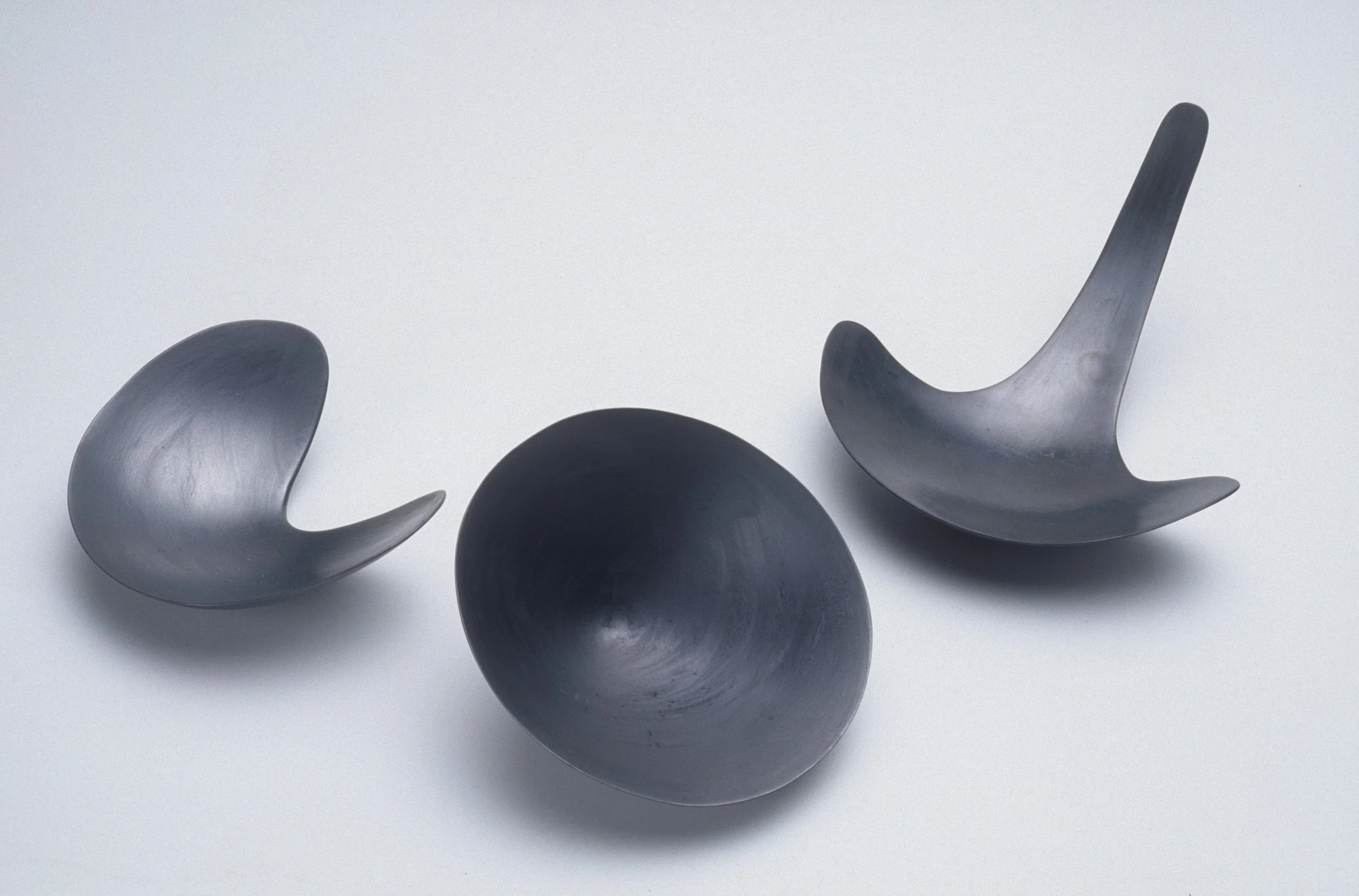
In “Memory of a Shard” (2025) we enter a surrealist universe, where the laws of physics appear upended. This arrangement of nine enigmatic pieces by artist, Andrea Barker for Tasmania Makes 25 program, are “poised, yet in a fragile state” as if their original intention has worn away, dissipated or lost. Forged in intense heat her works in porcelain are carbonised and reduced to black. She fuses the ancient and contemporary and plays with the most primordial of forms: the bowl, the hand held tool and the digging stick. Yet what each form appears to be and what they are, are uncertain. Their purpose is to intrigue, to defy curiosity, and raise questions.
This is a universe where things don’t sit flat. They tilt. Turn on an axis. Upend. Are suspended in space, teeter and try to find their balance. Barker takes the archetypal bowl shape that hurtles to us through time from the Neolithic pinch pot to its contemporary form, and subverts it. Her forms have a certain ambiguity, obey their own laws and are subject to breaking rules inherited through time. Contrary to their ancestral purpose, Barker’s bowl forms “can’t hold things,” things spill out,” and won’t “sit flat.” The bowl is no longer a container for substances such as milk, honey, water or rice. Instead, her bowls are “receptacles for ideas,” “stories” and “places to catch thoughts in.”
Each ‘bowl’ contains the spontaneous gesture of making. Their forms reference the evolution of pottery through time. Their bases are off-center and refer to historical pieces in archaeological sites. They contain memories of things dug up, fragments of forms that have been squashed, burnt, crushed and excavated, “their original meanings lost.” Barker sees these ephemeral states and uses them to drive her process.
She subjects her pieces to a microcosm of the tectonic process of time. Clay is shaped, beaten, warped, hung upside-down, scraped until their shapes appear, then sanded and polished until they are “tuned” and the forms reveal themselves.
Here the starting point for each work is the residue of what has been left behind in space and time. What we witness are traces drawn from Barker’s experience working on archaeological sites in the Middle East, such as Wadi Eth Themed in Jordan, an early Iron Age site, where they dug up pottery fragments, skeletons and carnelian beads. She describes developing an increasing “process of awe” and a curiosity to understand, “Who are these people? How did they live? What did they use pottery for?” For Barker the process of archaeological excavation itself is one of the primary influences in her work since. It’s ‘the crushing of rocks, the excavation of soil layers, sorting, pulverising, sifting, straining, refining, cleaning and archiving.” For a while, she worked as a photographer documenting and then drawing artefacts and pottery fragments from the dig site. She became attuned to intangibles, the great forces of nature. Gravity. Energy. Entropy. And developed a keen eye for the “peeling and wearing down of surfaces” through wind, weather, soil, fire, human use and destruction, and the relentless action of time on such fragments. She saw “an openness” in this process of erasure: the original form “scrubbed by time and a loss of memory.”
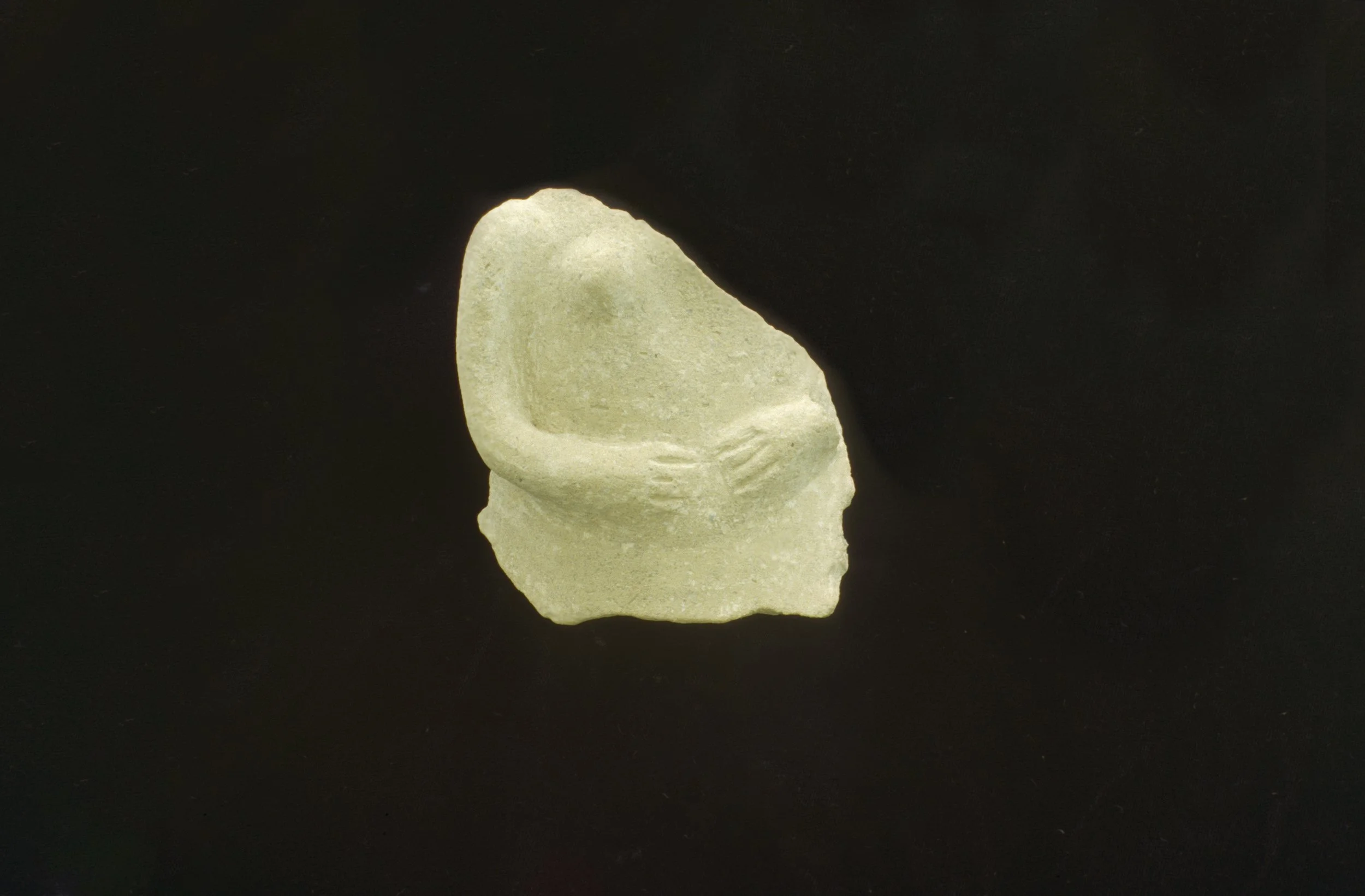
In Jordan, the archaeological team found remnants of silk and Nabatean trade objects. Barker speaks hesitantly, quietly, reverently. “There was pottery, low fired stoneware, terracotta treated with white slip, beautiful sandstones and the traces of an ancient language on fragments in Jordan that none of the research philologists could decipher.” During our conversation, Barker sends me a photo of one of her favourite pieces. It’s a fragment of a white slip coated, terracotta pottery shard, with a clearly decipherable torso of a small person, their hands almost clasped. I see it. I understand. She’s transmitted in an instant via this photo, a fragment, which distils what she’s about. It’s the fragility, the poignancy of this tiny shard, a type of archaeological daguerreotype, an ancient imprint of perhaps a loved or imaginary person, kept close as a talisman or reminder. If these shards could speak and for Barker they do. They reach through time. They move you. They seem to say: “Now you see me, fragmentary, incomplete, worn and wearing down. I am this moment in time. You find me before entropy completes my journey and I become erased and return to the grain of sands from whence I came and the infinite cosmos.”
The journey of the shard is through deep time. Clay. Kaolin. Earth. Bone. Ash. Quartz. Feldspar. These ingredients, these primal elements and materials, forged in the heart of volcanoes and stars, recycled, recomposed and reforged in high temperatures are then transformed into porcelain. Each shard contains the eons. They are decipherable. The record of a passage through an entropic universe wearing down through time.
Living at the American Center for Oriental Research (ACOR) during her residency in Jordan, Barker travelled to a network of sites, including the ancient Nabataean city of Petra. Light-filled Petra. Carved and built into sandstone canyons and passageways formed through millennia by weathering, erosion and tectonic activity. The city lies at the crossroads of ancient silk and spice routes between Arabia, Egypt, Syria-Phoenicia, the Mediterranean and the East. Barker speaks of her impressions. The things that stay with you during a lifetime and that she has drawn on for the past thirty years and subtly infuse her work. The stained surfaces of ancient walls. A clay tablet with a barely decipherable script. Worn down streets. Remote pathways. Lost objects and ancient ceramics. Her influences are “the ancient world, archaeological sites and ethnographic museums.” “Being an artist” she says, “means you can dip in and out of different histories and stories,” and that her work is “a compilation of these things.” She is not restrained by science, as an archaeologist is to data, to exactitude or time bound to a single era, rather Barker can make great leaps through time and bring together seemingly disparate ideas, objects, and surfaces into play.
In her art, in some ways closer to the pure lines in a Minoan fresco, a Brancusi, Isamu Noguchi, or Etruscan utensils, Barker has developed her own way of deciphering time. She folds time, bringing the ancient and the contemporary into play, and distils them into stand-alone and collected forms. In “Memory of a Shard” each piece resonates with each other. This is a tremulous world. It captures a feeling. A moment. The murmur of time. As if we’ve happened on a profound conversation or an otherworldly music that we need to listen carefully to. One, forged in silence, that cannot be heard only recognised at a glance, felt and deciphered from within.
“Memory of a Shard” was developed through Design Tasmania’s Tasmania Makes 25 program, (as part of an annual program in 2025). The Tasmania Makes 25 exhibition runs until 21 September 2025 at Design Tasmania, Launceston, Tasmania.
For O(Miro)s Eleftheriadis
Andrea Barker is a ceramic artist living in lutruwita / Tasmania. She has a Bachelor of Arts/ Ceramic Design from Monash University Melbourne. Her work has been exhibited nationally and internationally. Andrea’s works were awarded the first prize Clunes Ceramic Award, 2019, Honourable mention 4th Ceramic International biennale Korea 2007, and the Grand Prize ‘Poissond’Or’ International Triennale of Contemporary Porcelain, Nyon Switzerland, 2001. She is a member of the International Academy of Ceramics (IAC) and a current peer assessor for Arts Tasmania.
Andrea has undertaken numerous artist residences notably at Seto Art & Cultural Centre, Japan. She was awarded the Australia Council for the Arts Studio in Tokyo, Japan 2002 and residencies at Guldagergaard International Ceramic Research Centre, Skælskør, Denmark and the American Center of Oriental Research (ACOR), Amman, Jordan. Her work is held in both public and private collections including: The Art Gallery of Ballarat, History and Porcelain Museum, Nyon Switzerland, Taiwan Ceramic Museum, Yingge Taiwan, Musée Ariana, Geneva, Switzerland, World Ceramic Exposition Foundation, Korea and the Seto City Cultural Centre, Aichi, Japan.
Dr Catherine Payne is a writer born on Bundjalung country in North East NSW, Australia and has a Doctorate in Philosophy from the University of Sydney. She is a multi-award new media producer and has worked at the Australian Museum and ABC Science Online and as a lecturer in media art and documentary at various art schools and universities. Her research is interdisciplinary and includes interactive media, installations, essays and videos from across the fields of cinema and media art, cultural heritage and archaeology, Earth history and climate science. Her documentaries have been screened at film and video festivals in New York, London, Beijing and Belgium and her sound work has been broadcast on Radio National, triple j and at the Brooklyn Academy of Music, New York. Her work is held in collections at the Australian Museum Archive, ABC Listening Room, Screen Australia & National Library of Australia. Her essays have been published in national and international journals and anthologies. She is currently editing a book of essays on international film and video art by John Conomos.